Threatening truth (2005)
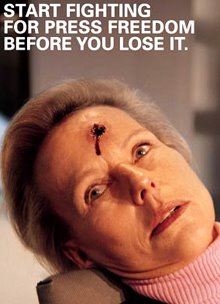
129 journalists dead in 2004
Freedom of the Press is being challenged. The international federation of journalists announced, a few weeks ago, that last year 129 journalists and media staff were killed “in action”, the worst record year so far. In an age where the world is so dependent on the media to report the truth, different journalist groups have started a campaign to bring the perpetrators to justice.
The 2004 IFJ report also mentions that state censorship and the constant intimidation journalists are faced with by the state and organized crime is intolerable and threatens the future of free press.
The 2003 report had already shown a worrying trend with 92 deaths, 22 more then in the previous year. Only in Iraq, 16 journalists were killed that year, not including the cases of Fred Nerac and Hussain Osman who are still missing and presumed dead in crossfire near Basra during the invasion. In the same year the missile attack on the “Palestine hotel” in Baghdad where 150 journalists were staying at, and the US troops attack on the offices of Al-Jazeera which killed Tareq Ayyoub ,received special attention and world condemnation as they were a clear attack on independent media. At the time, the IFJ called for 7 independent investigations but so far they have had little success.
7 dead in Colombia, including Juan Emitorio Rivas, a radio reporter famous for exposing political corruption, as well as 7 deaths in the Philippines have been singled out by the IFJ, completing the top 3 most dangerous areas for journalists. Palestine also deserved a special mention with the deaths of the Palestinian cameramen Nazeeh Darwazh and the freelance cameramen James Miller at the hands of the Israeli army.
In 2003, Asia had the worst record with 24 deaths followed by the Middle East with 23. Europe still counted 14 deaths.
Aidan White, the general secretary of the IFJ said in a press conference, “Behind each tragic death is a story of widespread intimidation and violence against journalists being carried on a large scale never seen before.” He went on to say, “There tends to be a few meaningless words of regret, a cursory inquiry and a shrug of indifference. It is inexcusable in an age when the world relies more then ever on media to tell the story that many governments fail to bring the killers of journalists to justice”.
The campaign led by the IFJ to reverse this critical situation came as a response to the Zahra Kazani incident in Iran, where the journalist was brutally tortured and killed in July 2003 while under police custody.
Robert Shaw, the IFJ Human Rights and Information Officer, said, “In order to put pressure on governments to support and protect journalists and media staffers, the global media community needs to increase efforts to ensure the practical implementation of existing international legal structures under the umbrella of the Geneva Conventions.” He added, “Organizations such as the European Union, the OSCE, the Council of Europe, the United Nations, etc, must be targeted to act as concrete intermediaries in order to push through this process. Aid should be checked and if necessary withdrawn when governments in these respective countries ignore basic humanitarian standards such as the freedom and safety of the press.”
The International News Safety Institute (INSI) was formed as a response, stating that journalists are not prepared to be intimidated and killed without a fight. Mr. Shaw said, “We believe that it is time for an international framework to be established to carry out independent investigations of the killing of journalists and media staff and to make the targeting and reckless neglect of journalists a war crime punishable under international law.”
The tragic death lists also hides another challenge journalists are forced to deal with nowadays, the increasing influence by corporate media groups and the state on free press. Corporate influence became major news in the mid-nineties with the Prosilac case. Fox news reporters, Steve Wilson and Jane Akre, exposed a complex network established by the chemical giant Monsanto in order to put RBGH, an artificial hormone that increases milk production and has been proven to be harmful to humans, on the market. The report described a series of corruption cases that later received attention by Canada and Europe who never considered RBGH to be a safe product. Faced with a lawsuit and the loss of advertising funds, Fox news began an 8 month campaign of intimidation towards Akre and Wilson, and eventually fired them for refusing to make drastic changes to their report. The journalists sued Rupert Murdoch`s Fox news and received 425 thousand dollars in compensation. The sentenced was later annulled when 5 major media corporations, including Media General and Newsweek, filled a complaint on the grounds that falsifying news was not illegal.
Robert Shaw said, “In order to fight this trend, the international media community must take a stance in order to push authorities to work harder to strike a balance between upholding the law and respecting civil liberties.”
In Britain, the similar case last December of the independent media center’s (indymedia) server being confiscated by the FBI, under an international security agreement, and without an explanation, raised questions of censorship.
Shaw said, “the attack on Indymedia late last year was most certainly a form of censorship. In fact, such actions demonstrate an increasing US government policy campaign to use other governments to push their own agenda”. He added,” The IFJ will continue to drive for greater protection of independent media such as Indymedia, who’s ability to exist and function effectively is essential to the strengthening of social democratic values in a globalised world plagued by the post 9-11 terrorism crackdown on civil liberties and freedom of the press”.
2004 was a dark year for journalism. Drastic changes need to be taken forward in the future to reverse this eminent threat to press freedom. If measures are not taken quickly, fair journalists are a race sentenced to extinction.
posted by Activix at 4:46 AM


0 Comments:
Post a Comment
<< Home